
Dick Cheney's passing is a reminder that Trump Republicans can also be Cheney Republicans
By Gary Abernathy
I’m a proud Reagan/Bush/Cheney Republican and a Trump-MAGA Republican. No apologies necessary.
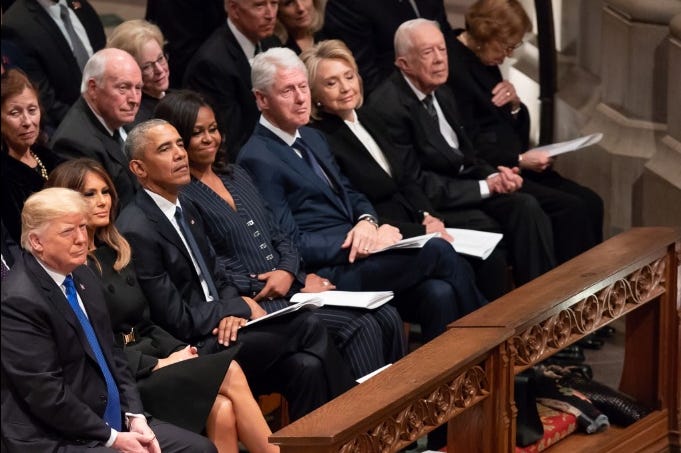
Dick Cheney’s death this week again brought up conflicted feelings among many Republicans who once considered themselves part of the Reagan-Bush wing of the Republican Party but are now firmly in the corner of Donald J. Trump. There are times when it feels like the choice is binary – you’re either a Reagan-Bush Republican, or a Trump Republican.
That choice seems even more obvious based on the animosity felt by the Cheneys – both Dick and daughter Liz – toward Trump, and returned in kind. It all started way back when Trump first began his presidential run in 2015 and stridently criticized the Bush family – remember, former Florida Gov. Jeb Bush was the leading GOP contender – for going into Iraq during George W. Bush’s presidency, as well as for not preventing the terrorist attacks of Sept. 11, 2001. The criticism naturally included Dick Cheney, Bush’s vice president.
Of course, most Republicans have likely concluded that Trump was right – the claim by “W,” Cheney and others in the Bush administration that Iraq was connected to 9/11 and was harboring weapons of mass destruction turned out to be untrue.
At one debate in early 2016, Trump declared, “Obviously, the war in Iraq was a big, fat mistake, all right? They lied. They said there were weapons of mass destruction. There were none, and they knew there were none.”
It was an astonishing break from the status quo GOP and a risky move by Trump. He could have alienated the bulk of Republican Party voters. Instead, the grassroots flocked in his direction while the “Never Trump” movement began to form, led by big GOP names but proving completely ineffective as a political force.
Bush 43 remained mostly silent about Trump’s opinions on 9/11 and its aftermath. But not Cheney, who defended the decisions of the Bush administration and said Trump sounded “like a liberal Democrat.”
“He clearly doesn’t understand or has not spent any time learning the facts about that period,” Cheney said in February 2016, while also predicting that Trump would not win the nomination, let alone the presidency.
After Trump lost re-election, and following the Jan. 6, 2021, Capitol riot, the animosity came into full bloom, with Liz Cheney, then in Congress, joining Democrats and a handful of Republicans in support of impeaching Trump, and her father amplifying his own criticism of Trump.
For most Republicans, Liz Cheney’s co-leadership of the Jan. 6 Committee was a bridge too far, and Republicans in Wyoming overwhelmingly cast her out when they had the chance.
The Cheneys’ subsequent 2024 endorsement of Kamala Harris over Trump was almost laughable in its demonstration of pure pettiness. It’s one thing to stand on principle against Trump and his philosophy or his personal faults. It’s another to abandon a lifetime of conservative principles to endorse a liberal Democrat for president. That seems much more a case of long-festering, deep-seated, personal resentment against Trump than a matter of choosing country over party, as the Cheneys claimed.
Like many in the GOP, I long considered myself a Ronald Reagan Republican. I was a supporter of George H.W. Bush, and an even more enthusiastic supporter of the second President Bush. Like most Republicans, I admired Dick Cheney as a tough, smart conservative fighter who was also one of the best defenders of the GOP philosophy. I’m proud of a photo taken with Cheney at a political event several years ago.
Some in the GOP seem to feel a tinge of guilt or perhaps divided loyalties when it comes to their modern-day support for Trump versus their past life as Reagan-Bush Republicans. There’s no need for that.
I’ll always be a Reagan-Bush Republican. Today, I’m a Trump-MAGA Republican, albeit with more appreciation for the MAGA movement itself – as it relates to secure borders, an America First foreign policy (which doesn’t mean isolationism, only that America is the first priority for the president) and pushing back hard against “woke” political ideologies – than for the chaotic and bombastic Trump, who too often can’t get out of his own way.
There is no conflict between the two. Why? Because times change. Circumstances evolve.
The old Republican Party was no longer winning elections, as demonstrated by the 2008 candidacy of John McCain and the 2012 campaign of Mitt Romney. The party needed to evolve and expand, as it did in 1980 behind Reagan. Trump, with an adjusted philosophy and a more populist appeal, reimagined the GOP in 2016.
The political landscape shifts, sometimes drastically. There is no more disconnect between being both a Reagan Republican and a Trump Republican than there is in being both a Bill Clinton Democrat and a Barack Obama Democrat, despite vast political differences between Clinton and Obama.
The animosity between the Cheneys and Trump was personal. It was understandable on that level, but it didn’t involve most Republicans. We don’t have to choose a side. We can appreciate them both.
Despite his personal animosity toward Trump, Dick Cheney should be revered by Republicans in particular, and most Americans in general. He served numerous administrations with honor. He articulated the conservative message with intelligence and class. He was unflappable in a crisis. He was a man to be admired.
Republicans can support Trump and mourn Cheney, remembering him with love and respect. There is no conflict between the two.
"The political landscape shifts, sometimes drastically. There is no more disconnect between being both a Reagan Republican and a Trump Republican than there is in being both a Bill Clinton Democrat and a Barack Obama Democrat, despite vast political differences between Clinton and Obama."
Good point. I hadn't thought of it that way.
"The party needed to evolve and expand, as it did in 1980 behind Reagan. Trump, with an adjusted philosophy and a more populist appeal, reimagined the GOP in 2016."
Commenting on the term "conservativism," (not GOP as in the above), terms need to have some sort of permanency or not be redefined in order to be informative. Specifically, has the term conservativism been redefined when we look at the shifts on trade, NATO, and budget deficits or should those shifts be considered to be associated with the GOP and not conservatism.